
What Are Tasting Notes in Coffee?
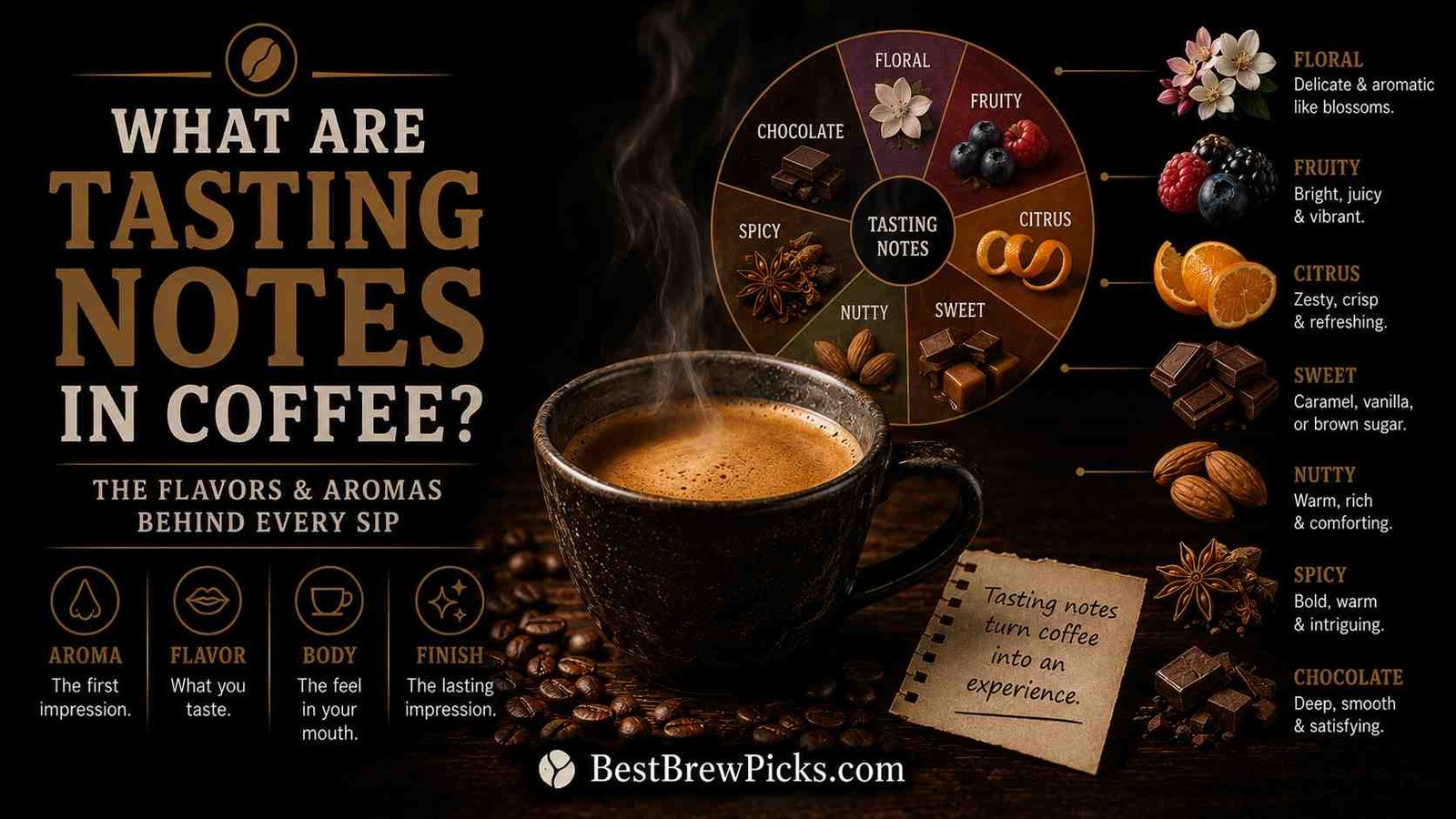
What Are Tasting Notes in Coffee? Tasting notes are descriptive flavor words that help explain how a coffee smells, tastes, and feels in the cup. They do not mean the coffee contains those ingredients. Instead, they describe the sensory impressions people notice, such as citrus, berry, chocolate, nuts, caramel, spice, or floral character.
This matters because tasting notes help coffee buyers make better choices before they brew. As more US coffee drinkers explore specialty coffee, origin coffees, and lighter roasts, flavor descriptions can guide them toward coffees they are more likely to enjoy. They also help readers understand why one coffee tastes bright and fruity while another tastes rich and nutty.
This article explains what tasting notes mean, why roasters use them, how to read them, and what the most common note families usually signal. It also shows how roast and brewing can change whether those notes appear clearly or get buried in the cup.
What Tasting Notes Mean

Tasting notes are sensory descriptions that help translate flavor into language. They usually reflect what a trained taster, roaster, or buyer perceives in the coffee after brewing. Therefore, they work as a guide, not a guarantee. If a bag says “blueberry” or “caramel,” that does not mean the coffee contains fruit or sugar. It means the cup reminds people of those flavors in some meaningful way.
These notes help people talk about coffee more precisely. Without them, most coffees would be described with very vague words like strong, smooth, or good. Tasting notes give you a better idea of what to expect. That makes shopping easier and tasting more interesting.
Notes can describe aroma, flavor, acidity, body, sweetness, and finish. Some notes feel obvious, while others emerge only when the coffee is brewed well. As a result, the same bag can seem different depending on grind size, water temperature, brew method, and freshness.
For a broader sensory framework, Coffee Flavor Wheel: Tasting Notes Explained helps organize flavor families. If you want to understand the coffee itself first, How to Taste Coffee Like a Professional gives you a structured approach to noticing those notes.
Why notes are descriptive, not literal
Tasting notes are descriptive because they capture resemblance. A coffee may remind you of berries without containing berries.
This language helps people share flavor experiences. It also keeps coffee conversations more specific and useful.
Why the same coffee can taste different
The same coffee can taste different because brewing changes extraction. Roast level, water, and grind all affect which notes stand out.
That is why tasting notes act as a starting point. They do not replace the cup itself.
Why Roasters Use Tasting Notes
Roasters use tasting notes to help customers understand a coffee before buying it. A good note can quickly signal whether the coffee leans fruity, chocolatey, nutty, floral, spicy, or earthy. Therefore, tasting notes reduce guesswork and make product labels more helpful.
These notes also reflect how the roaster wants the coffee to be understood. A light-roasted Ethiopian coffee might highlight jasmine and lemon, while a medium-roasted Brazilian coffee might emphasize cocoa and hazelnut. In contrast, a dark roast might stress toast, smoke, or bittersweet cocoa. The note choices tell you what the roaster thinks matters most in the cup.
Specialty coffee buyers often rely on notes because they want more than a simple strength rating. They want flavor clues. As a result, tasting notes have become part of the shared language of modern coffee buying, especially in the US specialty market.
The Specialty Coffee Association’s standards and sensory language help define how professional coffee evaluation works. You can read more in the SCA Coffee Standards. For how roast level changes what notes appear, Light Roast vs Dark Roast: Taste Differences gives useful context.
What notes help shoppers do
Notes help shoppers predict flavor more accurately. That means fewer surprise purchases and better coffee matches.
They also help you compare beans across regions and roast levels. That makes them useful even after you already know your preferences.
What notes do not guarantee
Notes do not guarantee the exact flavor you will taste. Brewing and freshness can change the cup a lot.
They also do not guarantee quality by themselves. A coffee can have attractive notes but still taste flat if it is stale or poorly brewed.
How to Read Tasting Notes
How to read tasting notes starts with looking for the broad category first. If a coffee says citrus, berry, caramel, almond, or floral, ask whether those words describe the main impression or a supporting detail. Broad notes tell you the overall style, while more specific notes tell you what flavor direction the coffee may take.
It helps to separate aroma notes from cup notes. Some coffees smell fruity but taste more chocolatey once brewed. Others smell nutty and then turn floral on the palate. Therefore, do not expect the label to match every impression perfectly. Think of the note list as a map, not a script.
You should also pay attention to the order of the notes. Roasters often place the most important or most noticeable notes first. If the label says “blueberry, cocoa, brown sugar,” the blueberry note likely plays the largest role. If it says “cocoa, almond, spice,” the coffee may lean more balanced and comforting than bright and fruity.
For a stronger tasting foundation, Understanding Coffee Acidity & Brightness helps explain why some notes feel lively. If you want to practice with real coffees, Whole Beans vs Ground Coffee: Freshness & Flavor shows why freshness affects how clearly notes appear.
Read broad notes first
Broad notes help you understand the coffee’s overall direction. Fruity, nutty, or chocolatey gives you a useful first frame.
Once you know that frame, the details make more sense. That makes shopping and tasting easier.
Use notes as expectations
Use notes as expectations, not promises. They tell you what the coffee may resemble.
That mindset keeps you from getting frustrated when the exact word does not show up. The coffee can still taste excellent even if it surprises you a little.
Common Note Families
Common note families usually fall into a few familiar groups. Fruity notes include citrus, berry, apple, stone fruit, and tropical fruit. Floral notes include jasmine, rose, and tea-like aromatics. Chocolate notes often include cocoa, milk chocolate, and dark chocolate. Nutty notes often include almond, hazelnut, and peanut. Sweet notes often include caramel, honey, brown sugar, or vanilla. Spice notes may include cinnamon, clove, or pepper. Earthy notes may include cedar, herbal, or smoky impressions.
These families often overlap because coffee flavor rarely stays in one lane. A single cup can feel fruity, sweet, and floral at the same time. Therefore, tasting notes work best when you think in layers rather than in one exact answer.
Origin and roast often influence which families appear most often. Lighter roasts often highlight fruit and florals, while darker roasts often emphasize chocolate, spice, and roast character. Washed coffees often taste cleaner and more transparent, while natural coffees often taste sweeter and more fruit-forward. As a result, the note family often hints at both origin and process.
For origin-specific examples, Ethiopian Coffee: Origin Taste Brands Reviewed shows how fruit and floral notes often appear in practice. For another flavor map, Coffee Flavor Wheel: Tasting Notes Explained can help you place each note family in a larger system.
Fruity and floral notes
Fruity and floral notes often signal brightness and clarity. They usually stand out more in lighter roasts and cleaner brew methods.
These notes appeal to people who enjoy a more expressive cup. They can feel lively, delicate, and complex.
Chocolate, nutty, and sweet notes
Chocolate, nutty, and sweet notes often signal comfort and balance. They appear frequently in medium roasts and blends.
These flavors often work well for daily drinking. They also pair nicely with milk or cream.
How Brewing Changes Notes

How brewing changes notes is one of the biggest reasons coffee descriptions can feel inconsistent. The same coffee can taste bright and juicy in pour over, heavy and soft in French press, or concentrated and intense in espresso. Therefore, tasting notes depend not only on the bean, but also on the method used to extract it.
Water temperature, grind size, brew time, and ratio all shape which notes you perceive. Under-extraction can hide sweetness and make a coffee taste sour or thin. Over-extraction can make a coffee taste bitter or dry, which can bury the notes the roaster listed. That is why brewing control matters so much if you want to taste what the label promised.
The Specialty Coffee Association recommends brewed coffee temperatures around 195 to 205°F. That range gives coffee a strong chance to express its notes clearly. If the water runs too cool, the coffee may taste muted. If it runs too hot, the coffee may taste harsh. Therefore, the label only becomes useful when the brew supports it.
For technique help, Pour Over Brewing Steps: A Beginner’s Guide explains how cleaner extraction can highlight notes. If you prefer a fuller cup, French Press Brewing Guide (Timing Water Temp) shows how body and texture affect what you taste.
- Use fresh beans to preserve clearer notes.
- Match your grind size to the brew method.
- Keep water temperature in a proper brewing range.
- Try the same coffee in two brew methods for comparison.
- Write down the notes you actually taste, not only the label words.
Tasting notes also affect buying decisions in a real-world way. A coffee with bright fruit notes may cost more because it comes from a carefully selected origin lot, while a more common chocolate-and-nut profile may offer better everyday value. That tradeoff matters if you want either more flavor complexity or a more affordable daily cup. In contrast, a premium note list does not always mean the coffee will fit your taste better.
For buying context, Single Origin vs Blended Coffee: Which to Buy? helps explain why note profiles differ so much. If you want a practical comparison of value, Coffee at Home vs Café: Cost Breakdown shows how taste preferences affect spending.
Conclusion
What Are Tasting Notes in Coffee? They are practical flavor descriptions that help you understand what a coffee may smell and taste like before you brew it. Once you learn how to read them, they become a useful shortcut for shopping, comparing beans, and improving your own tasting skills.
The main idea is simple. Tasting notes are guides, not guarantees. If you pair them with fresh beans and good brewing, they can make coffee easier to buy, easier to taste, and much more enjoyable to drink.